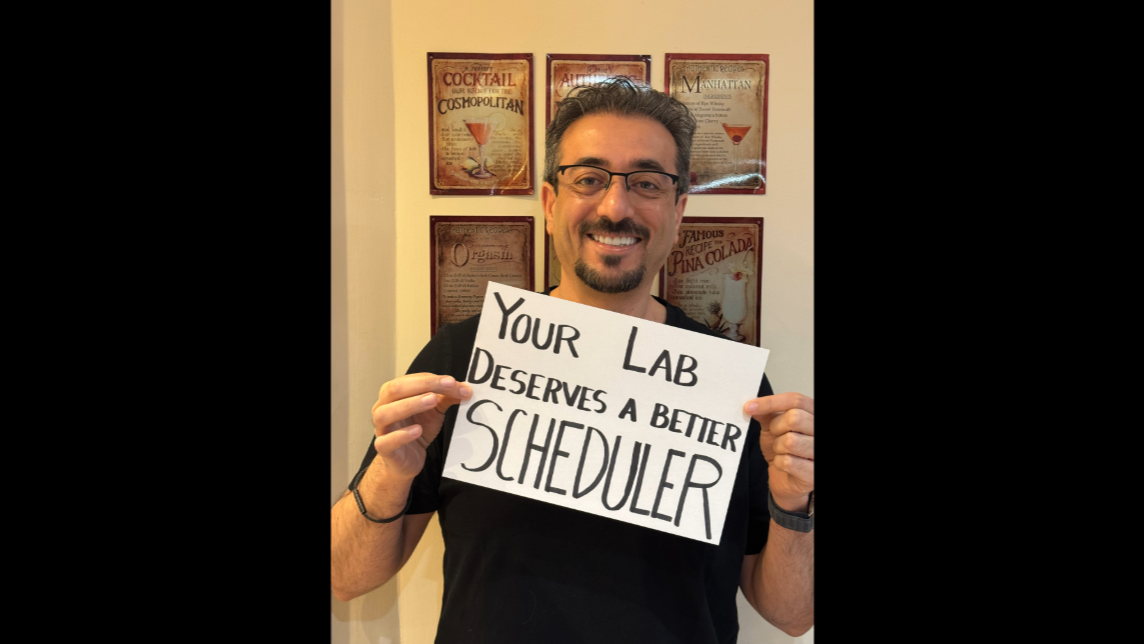
Here's something I've learned after 25+ years of building schedulers:
Scheduling is not the hard part. Respecting the science is.
The Industry Gets This Wrong
There's a common narrative in lab automation: faster schedulers equal better solutions.
I disagree.
My first scheduling project was eventually acquired by IBM. I've been building these systems for decades. And I can tell you that lab automation scheduling is fundamentally different from traditional project management.
Why Labs Are Different
In software projects, delays can be absorbed. Deadlines slip. Sprints extend.
In labs, time constraints are non-negotiable.
If an assay plate sits exposed for twenty minutes too long, the entire run can be compromised.
The consequences are irreversible:
- Reagents degrade
- Samples lose viability
- Financial losses occur silently
- Results become unreliable
The Three Layers of Lab Reality
Generic scheduling algorithms can't capture what actually matters in a lab:
1. Science
The protocols and timing requirements that define valid experiments.
2. Habits
The learned behaviors that often encode important constraints. That tip box loaded first? It might reflect reachability requirements, not arbitrary preference.
3. Superstition
Sometimes what looks like superstition is actually tacit knowledge that hasn't been documented.
Speed optimization that violates any of these produces unreliable results.
The Danger of Dynamic Scheduling
There are two common approaches:
Static schedulers calculate everything upfront. Problem: they fail during pauses. The moment something unexpected happens, the plan is useless.
Dynamic schedulers recalculate on the fly. Problem: they risk dangerous reschedules—reordering batches, violating exposure windows, prioritizing speed over consistency.
In scientific contexts, reproducibility matters more than throughput.
What Scientists Actually Need
Non-coding interfaces to specify:
- Labware movement sequences
- Reagent rest periods
- Incubation durations
- Consumable replacement intervals
- Conditional looping logic
Scientists need to encode their intent directly, without forcing workflows into algorithmic constraints.
How Lab Donkey Approaches This
We designed our scheduler with a different philosophy:
Control over optimization.
We don't promise the mathematically fastest schedule. We promise a schedule you can understand, predict, and trust.
- Transparent decision-making
- Consistent pause-resume behavior
- User control over system decisions
How to Evaluate a Scheduler
When you're looking at scheduling solutions, don't just ask "how fast?"
Ask:
- Can I see why it made each decision?
- What happens when I pause and resume?
- Who controls the system—me or the algorithm?
The answers matter more than the benchmarks.